Funny comic strip ideas
Funny comic strips usually rely on one of a handful of joke shapes: a misunderstanding, a role reversal, a literal reading, an escalation or an anticlimax. These 32 ideas are grouped by that shape, so once you see why a gag works you can write your own.
32 ideas · Updated 2026-11-09
Misunderstandings
Two characters read the same situation differently. The reader sees both versions.
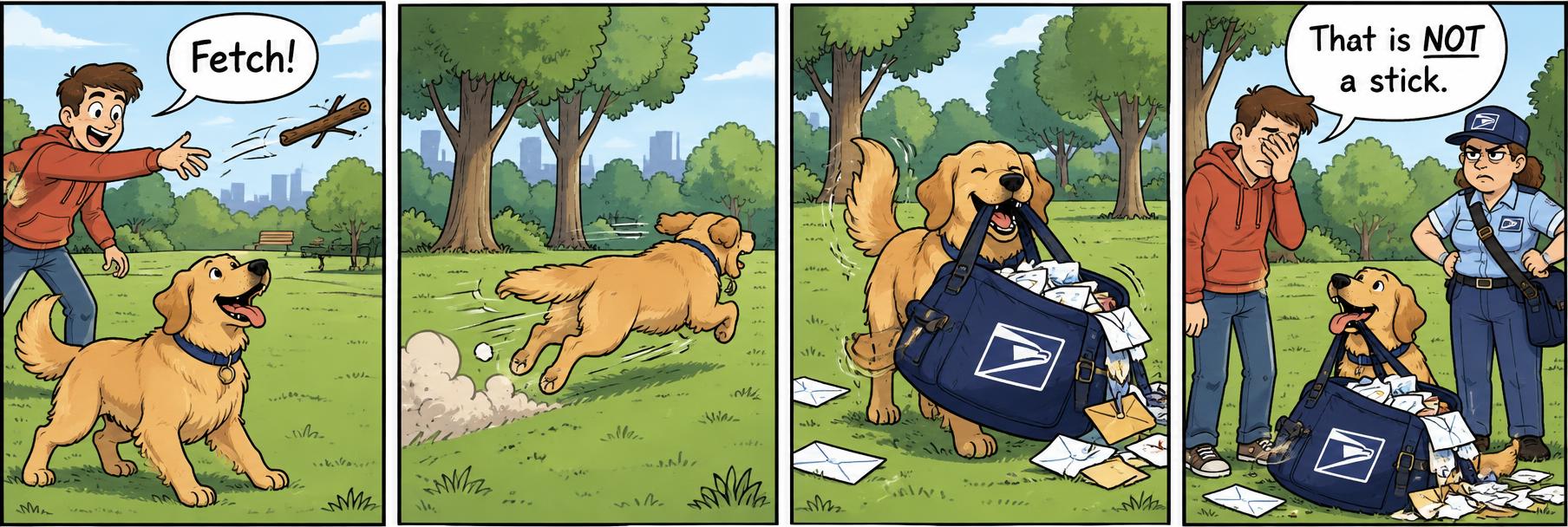
A dog is told to fetch and brings back the wrong thing entirely.
- Owner throws a stick
- Dog races off
- Dog returns dragging a mail carrier’s bag
- Owner facepalms in front of the mail carrier
"Fetch!" … "That is NOT a stick."
A kid is told to "clean your room" and interprets it creatively.
- Parent gives the order
- Kid gets to work
- Everything is crammed under the bed, the bed floating
A tourist uses a phrasebook to order dinner.
- Points at a phrase confidently
- Waiter’s eyes widen
- A live goat is brought to the table
Someone waves back at a person who was waving at someone behind them.
- Enthusiastic wave
- Realises the mistake
- Turns the wave into a long hair-fixing move
A smart speaker mishears a request.
- "Play relaxing music"
- Speaker thinks
- Air horn concert at full volume
Grandpa learns what "LOL" means.
- Grandpa texts "Grandma passed the salt LOL"
- Family confused
- Grandpa explains: "Lots of love"
A lifeguard thinks a swimmer is waving for help.
- Swimmer waves
- Lifeguard dives heroically
- Swimmer was waving at an ice-cream van
Role reversals
Swap who is usually in charge, and the normal rules become absurd.
A cat takes its human to the vet.
- Cat drags a carrier
- Human inside, protesting
- Vet: "Has he been eating his kibble?"
A teenager nags their parent about screen time.
- Parent scrolling at midnight
- Teen in doorway with arms folded
- "Phone. In the basket. Now."
Fish go fishing for a human.
- Underwater, fish lower a sandwich on a line
- A diver bites
- Fish high-five
A sandwich complains about being eaten.
- Person picks it up
- Sandwich looks nervous
- "At least use a napkin."
Customers serve the waiter.
- Exhausted waiter sits down
- Diners bring him soup
- He leaves a 20% tip and a review
Kids give the bedtime speech to their parents.
- Parents yawning on the couch
- Kids tuck them in
- "Ten more minutes of the news, then lights out."
Literal jokes
Take an expression at face value and draw what it would really look like.
Someone is told to "break a leg" before a show.
- Friend says "Break a leg!"
- Actor steps out
- Hospital-cast curtain call
Raining cats and dogs.
- Forecast says "raining cats and dogs"
- Umbrella up
- Puppies and kittens bouncing off it
Someone needs to "hold their horses".
- Impatient customer
- Clerk says "Hold your horses"
- Customer straining to hold three horses on leads
A cold shoulder.
- Couple fighting
- One turns away
- Their shoulder is a block of ice
Spilling the beans.
- Friends lean in for gossip
- "Okay, I’ll spill the beans"
- Kitchen floor covered in baked beans
Someone who has "butterflies in their stomach".
- Nervous before a date
- X-ray view
- A tiny butterfly disco inside
Escalation
A small problem gets bigger each panel until it is ridiculous.
A tiny spider in the bathroom.
- Spots a small spider
- Grabs a shoe
- Calls the army
- Spider still there, waving
A single typo in a group chat.
- Types "dinner at 8" as "sinner at 8"
- Friends react
- Church group invites appear
- Priest arrives
Trying to open a jar.
- Twists the lid
- Uses a towel
- Uses a car jack
- Toddler opens it in one turn
Someone tries to stay awake during a movie.
- Eyes open
- Eyes drooping
- Asleep
- Wakes up as the cinema cleaner sweeps around them
An itch in the middle of the back.
- Reaching
- Using a ruler
- Rubbing against a tree like a bear
- Neighbours filming
Adding "just one more" topping to a pizza.
- Cheese
- Ten toppings
- Pizza taller than the oven
- Delivery needs a crane
Anticlimax
Build up a big moment, then let it land with a quiet thud.
A dramatic countdown to a firework that fizzles.
- Crowd counts "3, 2, 1"
- Fuse sparks
- One sad "pfft" and a puff of smoke
An epic quest for the legendary sword.
- Hero climbs a mountain
- Lightning, chanting
- Sword in the stone has a "Sold" sticker
A long-awaited parcel arrives.
- Waiting at the window for days
- Box finally arrives
- It is a single sock
A magician’s big finale.
- Drum roll
- Lifts the cloth
- A slightly annoyed pigeon
Someone rehearses a speech all week.
- Practising in the mirror
- Steps onto stage
- Microphone is off for the whole thing
A thrilling car chase in a car park.
- Engines roar
- Tyres squeal
- Both cars stuck at the ticket barrier
The big reveal of a homemade costume.
- Months of work
- Door opens
- Everyone else at the party is wearing the same costume
Why these gags work
Most comic strip jokes have the same shape: the reader expects one thing, the last panel delivers another, and the gap between them is the laugh. A misunderstanding hides the gap in a character’s head. A role reversal hides it in who is in charge. An escalation stretches it until it snaps. When a strip isn’t funny, check whether the reader has enough information to expect the "normal" outcome before you subvert it.
Timing the punchline
Put the punchline in the last panel, as far right (or as low) as possible, so the reader cannot see it before they reach it. Keep the punchline panel’s dialogue shortest of all, or use no words. A silent reaction panel after a joke, the classic fourth beat, gives readers a moment to catch up and often gets the bigger laugh.
Common mistakes
Explaining the joke in a caption. Putting the funniest line in the middle panel. Cluttering the final panel with background detail that competes with the gag. Using a different camera angle every panel so the reader has to reorient. If in doubt, keep the camera still and let the characters change.
Questions
How do I make a comic strip funny?
Set up a clear expectation in the first panels, then break it in the last one. Keep the punchline short and place it where the reader sees it last.
How many panels should a funny comic strip have?
Three or four. Three panels give setup, turn and punchline; a fourth adds a reaction beat after the joke, which often makes it land harder.
Are silent comic strips funny without dialogue?
Often funnier. Without words, the expressions and timing carry the joke, and the strip reads in any language.
What kinds of jokes work best in comics?
Visual ones: literal readings, sudden reveals, escalation and reactions. Puns work too, but the panel should show something the words alone could not.