How to Make Comics When You Can't Draw
Updated 2026-11-12
You can make good comics without being able to draw. Readers follow a comic because of clear storytelling: readable panels, expressive faces and timing. Stick figures, simple shapes, traced photos, collage and AI-generated art you edit yourself can all carry a story. Pick the method that matches your goal, then spend your effort on the writing.
Why drawing skill matters less than you think
Comics are a sequence, not a gallery. A reader needs to recognise who is who, see what changed between panels and read the words in order. Some long-running webcomics have used very simple drawings for years because the writing and timing carry them.
So the real skills are: picking one moment per panel, staging it clearly, and keeping characters recognisable. All of these can be learned without learning to draw.
1. Stick figures, done well
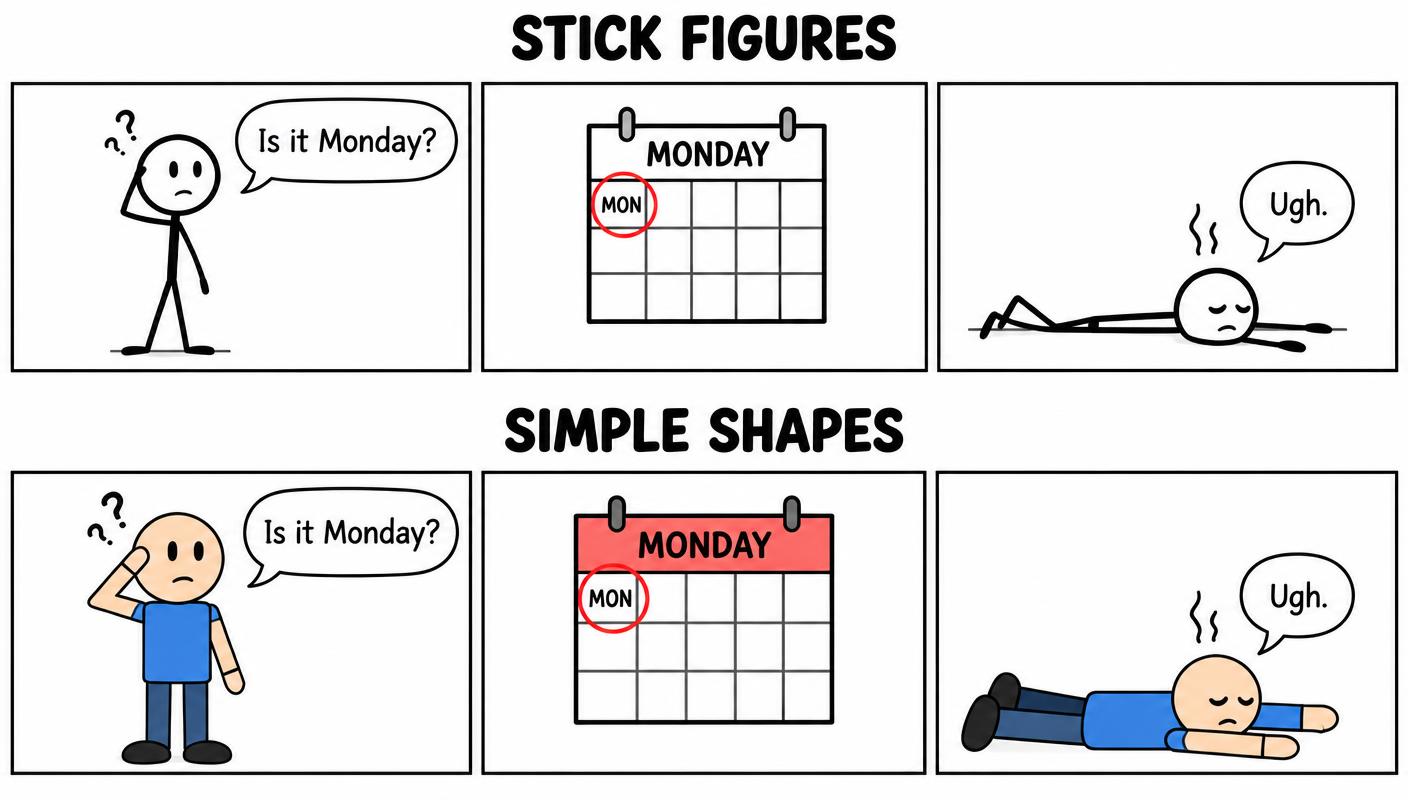
Stick figures work when the pose and face are clear. Give each character one distinguishing feature: a hat, a ponytail, glasses. Bend the lines: a curved spine reads as tired, a straight one as alert. Draw the eyes and mouth bigger than feels natural; expressions do the heavy lifting.
- Give every character one signature shape or accessory
- Exaggerate poses: arms up for joy, slumped for defeat
- Keep backgrounds to one or two props that explain the setting
2. Characters built from simple shapes
Step up from sticks by building bodies from circles, rectangles and triangles. A round head on a rectangle body with tube arms is easy to repeat panel after panel, which matters more than detail. Flat colour makes characters instantly recognisable even when small.
3. Tracing and photo reference
Pose yourself or a friend, take a photo, and trace the outline on a light layer or a window. Tracing your own photos is a long-standing way to get natural poses and hands right. Simplify as you trace: keep the silhouette and face, drop the folds and texture.
Don't trace other people's art or photos for anything you publish; use your own pictures or properly licensed references.
4. Collage and found images
Cut-out photos, magazine clippings or public-domain images arranged in panels make striking comics with no drawing at all. Add speech bubbles and captions on top. This works well for zines, classroom projects and parody, as long as you have the right to use the images.
5. Templates and layouts first
Starting from a blank panel template removes one of the hardest decisions. Print a blank strip, rough in the beats with stick figures, then decide whether to redraw, collage or go digital. Many 'can't draw' problems are really planning problems that a template solves.
6. AI-generated art you edit yourself
AI image tools can produce characters and backgrounds from a description. The trap is generating a whole page at once: text gets baked into the image, characters drift between panels and one bad hand means rerolling everything.
A better workflow is to generate pieces (a character, a location) and assemble them yourself, keeping speech bubbles as real editable text. In Comic Creator you set a project style, create a reusable character, generate empty backgrounds, then arrange and letter each panel; you can move, flip, crop or resize anything without regenerating.
Which method should you choose?
Match the method to the goal rather than to your confidence level.
| Goal | Good fit |
|---|---|
| Daily practice or quick jokes | Stick figures or simple shapes |
| Classroom project | Templates plus stick figures or collage |
| Natural poses and acting | Tracing your own photos |
| Polished, colourful pages | AI-generated pieces you arrange and letter |
| Zines and parody | Collage |
Make the storytelling carry it
Whatever the method, the same rules make a comic readable: one moment per panel, the same character always looks the same, faces are big enough to read, and the most important line or reaction lands in the last panel. Write your script first and the art becomes a series of small, manageable choices.
- Write the beats before drawing anything
- Give each character one recognisable feature
- Keep the camera steady unless the moment needs a change
- Leave room for speech bubbles
- Put the payoff in the final panel
Key takeaways
- Clear storytelling matters more than drawing skill.
- Simple, repeatable characters beat detailed ones you can't redraw.
- Trace only your own or licensed references.
- With AI art, generate pieces and assemble them yourself so everything stays editable.