Comic strip ideas for school
A good school comic strip shows understanding, not just drawing: each panel should capture one step, cause or idea. These 32 prompts are organised by subject, with the beats already split into panels, followed by tips for setting the task and assessing the results.
32 ideas · Updated 2026-11-16
Science
Processes and cycles map naturally onto panels: one stage per frame.
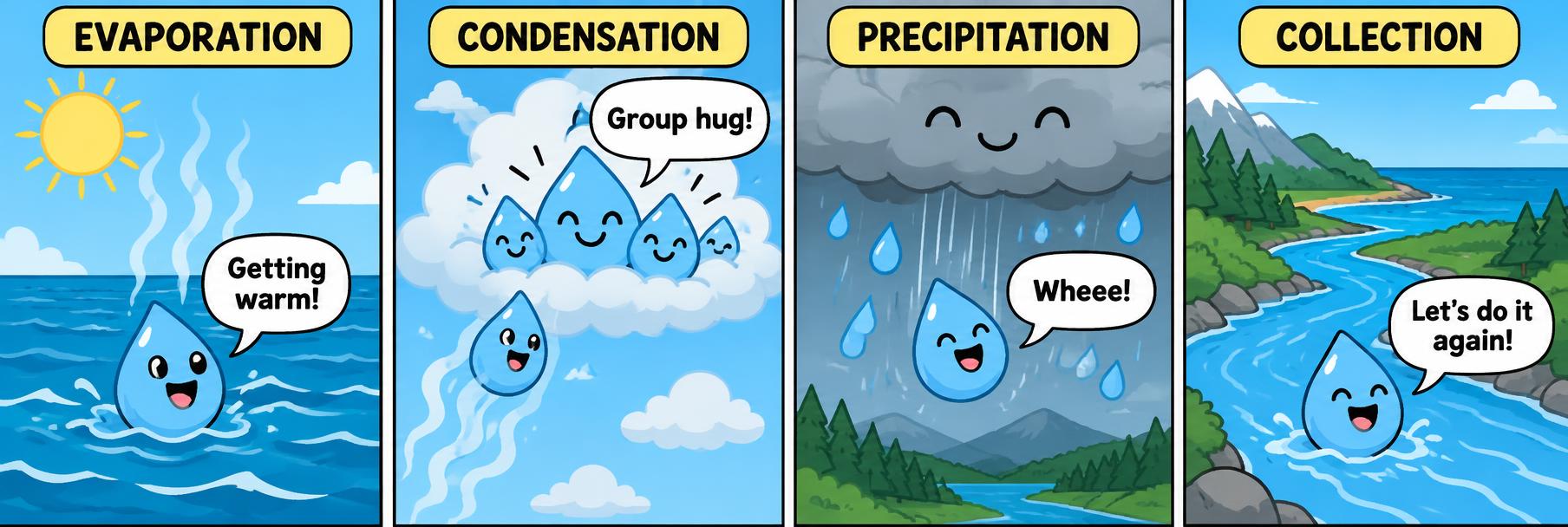
A raindrop narrates its trip through the water cycle.
- Evaporation from the sea
- Condensation in a cloud
- Precipitation as rain
- Collection in a river
"Getting warm!" … "Group hug!" … "Wheee!" … "Let’s do it again!"
A seed explains how it grows into a plant.
- Planted in soil
- Roots and shoot appear
- Leaves catch sunlight
- Flowers and new seeds
A food chain told as a chain of lunches.
- Sun feeds grass
- Rabbit eats grass
- Fox eats rabbit
- Decomposers recycle the fox
A red blood cell’s daily commute.
- Picks up oxygen in the lungs
- Rides through arteries
- Delivers to a muscle
- Returns for a refill
Newton’s three laws on a skateboard.
- Board stays still until pushed
- Harder push, faster board
- Skater pushes wall, rolls back
States of matter at an ice cube’s birthday party.
- Solid ice cube
- Melts into a puddle
- Evaporates into a cloud of guests
A magnet tries to make friends.
- Attracts paperclips
- Repels another magnet’s north pole
- Finds a south pole and sticks
Language arts
Comics make comprehension visible: what happened, why, and how a character felt.
Retell the key scene from a book you are reading in four panels.
- Setting and characters
- The problem
- The turning point
- How it is resolved
Show the same moment from two characters’ points of view.
- Character A’s view
- Character B’s view of the same event
Illustrate three new vocabulary words in one story.
- Use word one in context
- Word two
- Word three in the punchline
A punctuation mark goes on strike.
- Commas quit
- Sentences run together breathlessly
- Commas return to applause
Rewrite a fairy tale’s ending.
- Familiar opening
- The point where it changes
- The new ending
An idiom acted out literally, then explained.
- Literal drawing of the idiom
- What it actually means in a real situation
A character’s diary entry turned into panels.
- Morning mood
- What happened
- How they feel at the end of the day
Maths
Characters make abstract ideas concrete and memorable.
Fractions share a pizza.
- Whole pizza
- Cut into halves
- Then quarters
- Someone asks for the "biggest" eighth
Zero feels left out.
- Numbers on a team
- Zero ignored
- Zero stands next to 1 and makes 10
A word problem told as a comic.
- The situation with numbers
- The question
- Working it out
- The answer in context
Shapes argue about who has the most sides.
- Triangle brags
- Square laughs
- Circle: "I have infinite… or none?"
A number line road trip with negative numbers.
- Starting at zero
- Driving into negatives
- Temperature drops below freezing
Setting the task
Give a fixed panel count, usually three or four, and a clear job for each panel ("panel one: the setting; panel two: the problem…"). Constraints make the task finishable and make understanding easier to see. Show one example, then let students choose their own characters. Allow stick figures so time goes into thinking rather than drawing.
A simple marking guide
Content: each panel shows a correct, distinct step or idea. Sequence: the order makes sense without explanation. Language: captions and dialogue use subject vocabulary accurately. Clarity: a classmate can read it without help. Effort on art can be noted, but should rarely decide the grade.
Printables and going digital
Print the blank strip worksheets with empty speech bubbles or writing lines for younger writers. Older students can draft on paper and then rebuild the strip online in Comic Creator, where characters, backgrounds and text stay editable. Follow your school’s policies before students use any AI tool; an adult should review generated images first.
Questions
What is a good comic strip idea for a school project?
Pick a process, event or story you are studying and give each panel one step: setting, problem, turning point, result. That shows understanding clearly.
How do you grade a comic strip assignment?
Mark the content and sequence first: is each panel accurate and in a logical order? Then language and clarity. Keep drawing skill a small part of the grade.
What age is a comic strip project suitable for?
Most ages. Younger students do well with two or three big panels and bubble worksheets; older students can handle four panels, captions and research.
Can students make school comics without drawing?
Yes. Stick figures, cut-out collage or editable digital characters all work. The thinking in the sequence is what matters.